Monday, August 8, 2011

Spice Rubbed Mahi Mahi


This meal is great for summer! It is super easy to make, very healthy and great for recovery from a tough workout - not to mention delicious! We used a (wild caught) Mahi Mahi fillet with the skin left on (most of the healthy oils in fish that are great for your skin, cholesterol, and managing inflammation are found in the skin so we recommend leaving it on). The fillet was rubbed with a spice blend containing salt, pepper, granulated garlic, onion powder, chili powder, and lemon zest. When preparing your rub don't get caught up in exact measurements add the ingredients and then put a dab of the rub on you finger and adjust until you reach your desired taste. We let the rub sit on the fish for about 30min before searing the fish on a very hot grill. Depending on the thickness of the fillet, fish is usually good for about 5-6min on each side as you want the center to be slightly opaque and tender. While the fish was marinating we cooked the corn on the grill (in the husk), steamed some long grain organic rice, and made a fresh guacamole using avocado and a freshly made salsa which included diced tomato, red onion, garlic, jalapeno, a little lemon juice, and salt. All you need to do is mix these ingredients with your mashed avocados and BAM you have an amazingly fresh guacamole to serve as the perfect cool compliment to the spice rub on your fish. All in all this meal is only about 400 calories and has a perfect blend of protein, healthy fats, complex carbohydrate, and best of all it only takes about 45 minutes (tops) to make. Give this a shot - we know you will love it!    

Monday, August 1, 2011

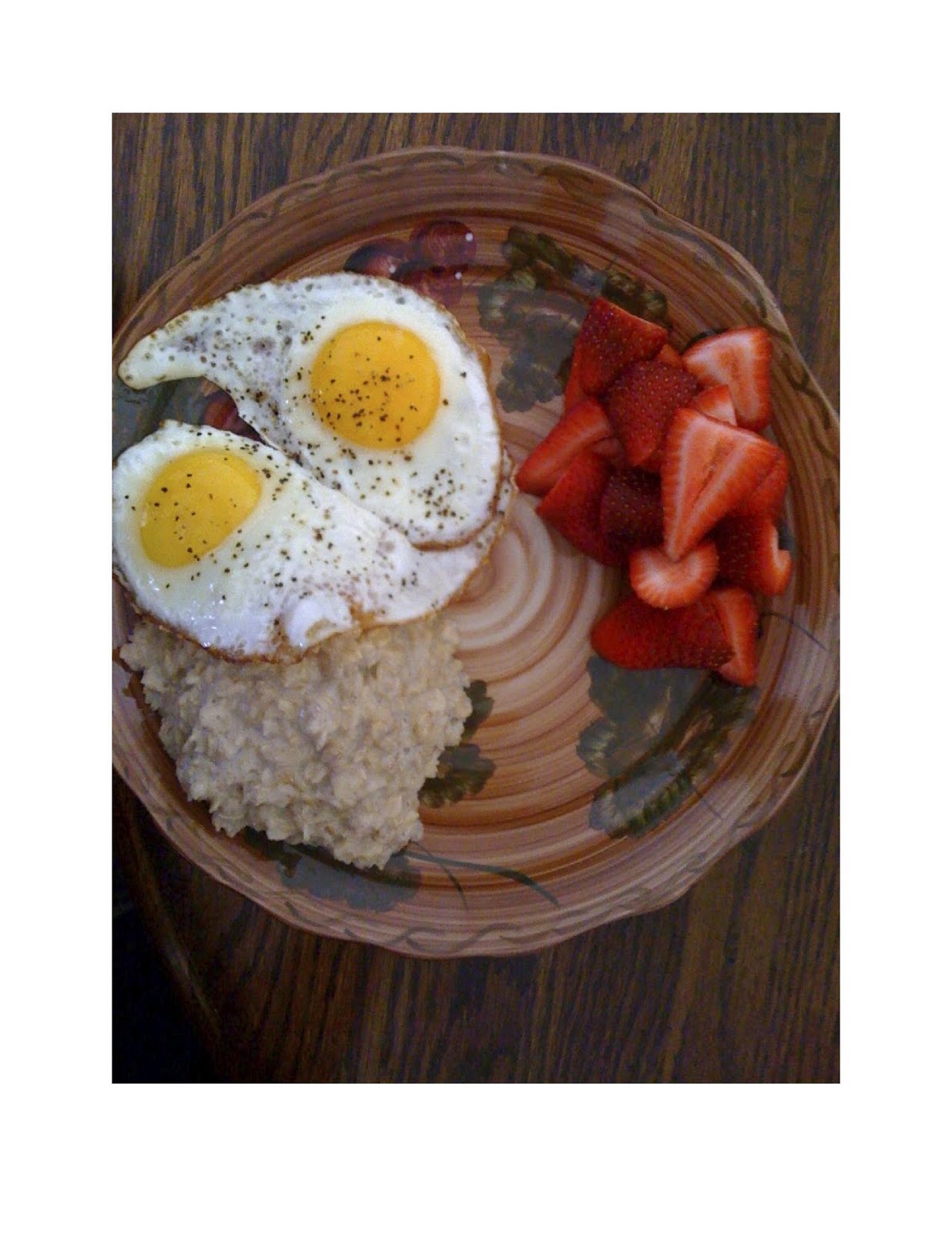
The Perfect Breakfast

This breakfast has all of the components to fuel your body, give you adequate nutrients, and help to stave off hunger for at least a few hours. This meal is also super easy to make and really doesn't have to be eaten strictly for breakfast as it would also serve as a perfect POST workout recovery meal as well. The oatmeal is steel cut organic oats that we cooked for about 10min in some organic soy milk (about 1/2 cup oats per cup of milk) and a tablespoon of brown sugar. The eggs are sunny side up cooked in a little bit of vegetable oil and seasoned with some salt and pepper and then sliced strawberries gives you a great burst of sweetness and vitamin C. This meal contains about 300 calories and about 20g of protein and some serious complex carbohydrates and fiber to keep your blood sugar steady and to keep you adequately fueled for intensive training. Start your day with a breakfast like this and you are sure to ramp up your metabolism, feel energized, and avoid any unwanted morning snacking. Enjoy! 

Wednesday, July 27, 2011

Awesome Recovery Meal

This meal is really great after a hard days training as it will provide a great source of quality nutrients, glycogen replenishment, as well as healthy protein and fats. To make this all you need is some fresh fish (we used WILD caught Pacific Rockfish. Note: it is always far healthier to choose a wild caught fish versus a farm raised fish. This is simply due to the fact that farm raised fish are not found out in the ocean in their natural element and are farmed in very close and compacted living quarters with sometimes very questionable sanitary conditions) some rotelle pasta, fresh garlic, spinach, onion, red pepper, 1/4 stick unsalted butter, and a ripe lemon. For the fish we coated them in a mix of organic flour, some dried oregano, basil, thyme, salt, pepper, and a touch of paprika and cooked them for a couple minutes on each side in a hot pan with a little vegetable oil. We also cooked the minced garlic, spinach, red pepper, and onion in a pan for about 6-8min. Once we boiled and strained the pasta we combined the pasta and veggies in a pan with the melted butted and fresh squeezed lemon juice. Then we simply flaked the fish on top and sprinkled a very small amount of shredded cheese and we had a super tasty complete meal that helped to replenish after a tough day of training. All in all this meal took about 40min to prepare and cook and it offers quality carbohydrate, healthy fats, good protein, and a lot of vitamins and minerals from the garlic, spinach, onion, pepper, and lemon. Stay tuned for more healthy recipes to provide optimal fuel for your active lifestyle!   

Monday, July 25, 2011

Healthy Burger & Fries

Just because you are eating a diet based on minimally processed foods doesn't mean you have to give up the staples of comfort food. As long as you make some minor adjustments there is no reason you can't fit our modified version of a cheeseburger and fries into your diet. What we have done here is taken 90/10 lean ground beef and seasoned with some salt, pepper, basil, thyme, parsley, and a touch of garlic powder. We then grilled the burger so the excess fat will drip away and melted a 1/4 cup of a reduced fat cheddar/jack cheese blend on the patty. In the spirit of keeping it non-processed we skipped the bun and replaced the traditional french fries that are high in saturated and trans fats with roasted red potatoes that also contain a blend of sweet onion and red pepper. Finally to give it a summer feel we added some cool fresh watermelon which provides a satisfying sweetness without all of the calories and refined sugars of a soda or milkshake. The total calories in this meal is only about 400 (a fraction of a burger and fries from a traditional fast food joint) and is packed with protein, complex carbohydrate, and quality nutrients from the fruits and vegetables. Give this a try and we promise you will not miss the refined bun, greasy fries, and sugary soda!   

Wednesday, July 20, 2011

Healthy Snacking Options

When people are out and about for a quick bite to quench hunger they often can find very healthy non-processed options in some of the least expected places. A lot of times people will search the nearest fast food spot, or sandwich shop, or even pick up a pastry at Starbucks with their coffee. Most of the time these options are high in fat, sodium, and refined sugars. They will likely cause spikes in blood sugar and potential unwanted fat storage. However, the picture you see above is an eight piece spicy tuna roll with fresh minced tuna, avocado, sprouts, and wrapped in cucumber and best of all it was made right in front of me! Which sushi restaurant did I have to call in advance and then drive to to pick this up? I purchased this snack from the local grocery store where they have an employee who makes fresh sushi everyday from 10-2. The best part this only cost me $7 and packed only about 250 cals. Not only that but it is rich in protein, unsaturated fat, it's non-processed, and very delicious. The moral of the story here is for the same cost of a meal at a fast food restaurant I was able to get a very healthy low calorie meal with quality ingredients to tied me over for a couple hours. These are the kinds of strategies that can make or break an eating plan and the more strategic you can get the greater your chances will be for success in your program!    

Tuesday, July 19, 2011

Super Post Workout Meal


This is a very simple meal that would work very well post workout and is easy to make. There are a lot of quality nutrients and the total calorie count is pretty low. The steak is a 4oz sirloin (the leanest cut you can buy) that has been seared with a simple rub of salt, pepper, paprika, chili powder, and a touch of brown sugar. The egg is sunny side up to add some creaminess and depth of flavor to the steak. The potatoes are a blend of sweet and red potatoes cooked with a little vegetable oil and mixed with red pepper & onion. Finally we have some sliced fresh cucumber with a touch of organic thousand island. All in all this meal yields about 400cals and has a lot of vibrant color and best of all the only real processed ingredient is the salad dressing but the amount is pretty negligible as it equates maybe a teaspoon. If you were to eat a meal like this at a restaurant you would easily be looking at probably 900cals but with a simple preparation of about 20min you get all the satisfaction of steak and eggs with half the calories. Stay tuned as we will continue to update our blog with simple & delicious healthy meals to compliment your hard work in the studio.     

Monday, March 21, 2011

Overload...The Gateway to Results

When people want to get into a new fitness routine there is often intensive thought put into deciding what is ultimately going to give them the best bang for their buck. Should it be yoga, pilates, personal training, a general gym membership, or some combination of all the above? Regardless of what option you choose the most important component of training is a concept called OVERLOAD. Overload is defined as imposing a stress on the body that it is not normally accustomed to. This is something that is initially very easy to achieve when first beginning a training program; however, after the first 4-6 weeks the "honeymoon phase" ends and the body needs to be challenged much more creatively to continue to spark noticeable results. The goal is to be using this overload principle to achieve an adaptation that is known as SUPERCOMPENSATION. Supercompensation is the condition where the body has now physiologically adapted to the exercise stimulus and can now tolerate a greater stress. This act of supercompensation results in improved strength & endurance, greater cardiovascular efficiency, reduction in body fat, and improved metabolic rate, to name a few.

The question now becomes how do we continue to get overload on a long term scale? We can do this several ways. One would be altering choice of equipment. Implementing strategies like using kettlebells for 4 weeks, then switching to stability balls, then incorporating some body weight work, and then a blend of all 3 can continue to challenge the body to adapt. Another way to induce overload is to challenge physiological response. This can be done by playing with sets, reps, load, rest periods and finally tempo. An example of this would be workouts done at a slower tempo with higher load and longer rest periods interchanged with workouts using lighter weight, a faster tempo, and shorter rest periods. Finally you can continue to impose overload onto the body by increase difficulty in proprioceptive response. This can be achieved by using single leg & single arm exercises, removing bases of support and adding unstable bases of support in place of stable bases of support.

These strategies all really drive home the principle that intensity in training is always relevant to the situation. Greater intensity does not always mean harder and harder until we are pushing our bodies to the brink of injury. Intensity can be viewed as modifying difficulty subtly with how we address the specific variables in training. If someone goes from sets of 6-8 with 2 minute rest periods to sets of 15-20 with 30sec rest periods this will drive intensity while actually decreasing the necessary load. This really demonstrates that intensity is all in the variables and application. At BT Fitness, we are constantly putting these variables into use to ensure that our clients are continuously placed in new and challenging environments with their training so that adaptation remains constant and results remain consistent!